
Moissanite vs. Diamond: The Ultimate Comparison
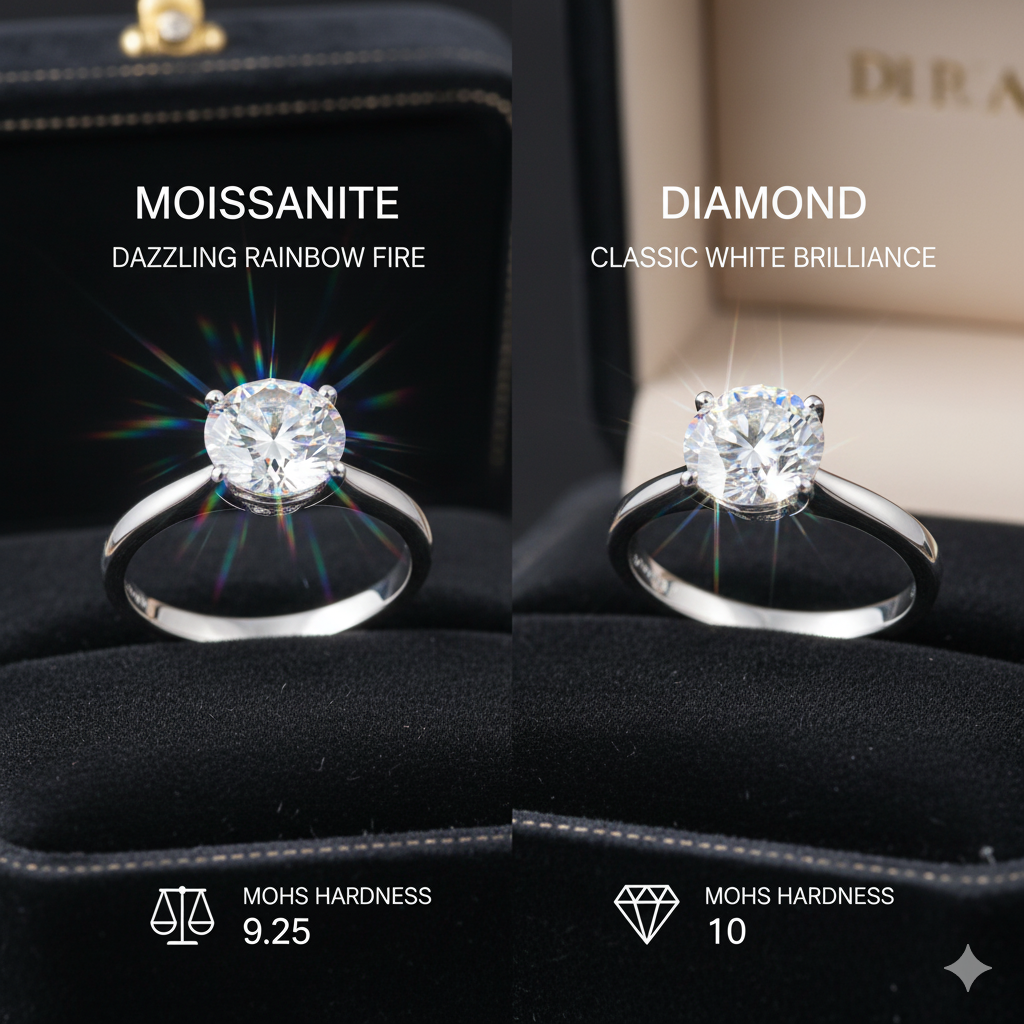
In the world of fine jewelry, few comparisons are as enduring and debated as moissanite vs. diamond. For centuries, the diamond has been the undisputed king of engagement rings and precious stones, celebrated for its unparalleled brilliance, hardness, and timeless appeal. However, in the modern age, a new contender has emerged, captivating consumers with its own unique properties and ethical advantages: moissanite. This article will provide an ultimate, side-by-side comparison of these two remarkable gemstones, helping you make an informed decision for your next significant purchase.
What is Moissanite? A Gemstone of Cosmic Origins
Moissanite is a naturally occurring mineral, a silicon carbide crystal, that was first discovered in 1893 by Nobel Prize-winning chemist Henri Moissan in a meteor crater in Arizona. For many years, natural moissanite was exceedingly rare, found only in trace amounts in certain rocks and meteorites. This rarity led scientists to develop a way to create gem-quality moissanite in a laboratory, a process that mimics the conditions under which the stone forms naturally.
Today, virtually all moissanite used in jewelry is lab-grown. This distinction is crucial, as it ensures a conflict-free and environmentally responsible source. Unlike diamonds, which are mined, moissanite is created with minimal environmental impact, making it a favorite for the eco-conscious consumer.
What is a Diamond? Earth’s Most Famous Gem
A diamond is a natural mineral composed of pure carbon, formed deep within the Earth’s mantle under extreme heat and pressure over billions of years. Mined from the Earth, diamonds have been a symbol of wealth, power, and everlasting love for centuries. Their value is determined by the 4 Cs: Cut, Clarity, Color, and Carat weight, a grading system established by the Gemological Institute of America (GIA).
While most diamonds are mined, the rise of lab-grown diamonds has introduced a new player into the market. These are chemically, physically, and optically identical to mined diamonds but are created in a controlled laboratory environment. They offer a more sustainable and often more affordable alternative to their natural counterparts.
The Ultimate Head-to-Head: Moissanite vs. Diamond
While they may look similar to the untrained eye, moissanite and diamonds have distinct differences in their physical, chemical, and optical properties. Understanding these will be key to your decision.
1. Brilliance and Fire: The “Sparkle” Factor
This is where the most noticeable difference lies. Brilliance refers to the white light reflected from a gemstone’s surface, while fire is the dispersion of light into a rainbow of colors.
Moissanite: Moissanite has a higher refractive index than a diamond, meaning it bends light more effectively. This results in a superior, almost dazzling fire and brilliance. Its sparkle is often described as “rainbow flashes,” especially in direct sunlight or bright light. This unique characteristic is one of moissanite’s most celebrated features.
Diamond: A diamond’s brilliance is known for its classic, white, and intense sparkle. While it also exhibits fire, it is less pronounced than moissanite’s. A diamond’s sparkle is often described as a series of intense, single flashes of white light.
2. Hardness and Durability: The Mohs Scale
The Mohs Hardness Scale measures a mineral’s resistance to scratching. This is a critical factor for a stone intended for daily wear, like in an engagement ring.
Moissanite: Moissanite scores a remarkable 9.25 on the Mohs scale, making it one of the hardest gemstones known. It is second only to diamonds and is more durable than sapphires and rubies. This high score means it is incredibly resistant to scratches, abrasions, and chipping, making it an excellent choice for a lifetime of wear.
Diamond: The diamond is the hardest mineral on Earth, scoring a perfect 10 on the Mohs scale. This makes it virtually scratch-proof and the ultimate symbol of durability.
3. Color and Clarity
Moissanite: Modern moissanite, especially from top manufacturers, is graded on a similar scale to diamonds. The highest quality moissanite is graded as D-E-F on the diamond color scale, meaning it is considered “colorless”. Due to its superior light performance, some moissanite can show very subtle color tints in certain lights, though this is far less common in today’s high-quality stones.
Diamond: Diamonds are graded from D (colorless) to Z (light yellow or brown). The less color a diamond has, the more valuable it is. Similarly, clarity refers to the presence of internal inclusions and external blemishes. Both moissanite and diamonds are available in high-clarity grades, though moissanite is often created with near-perfect VVS1 clarity.
4. Price and Value
This is perhaps the most significant differentiator for many consumers.
Moissanite: Moissanite is substantially more affordable than a comparable-sized diamond. Its price is based on the size and quality of the stone, not its rarity. This allows consumers to purchase a much larger, more brilliant, and higher-quality stone for a fraction of the cost of a diamond.
Diamond: The price of a diamond is a function of its rarity, global supply, and the 4 Cs. Prices escalate dramatically with carat weight and quality. This can make larger, higher-grade diamonds financially unattainable for many.
Conclusion: Which One is Right for You?
The choice between moissanite and a diamond is deeply personal. There is no single right answer, only the best choice for your values, budget, and aesthetic preferences.
Choose a Diamond if… you value a natural, traditional gemstone with a storied history. You are drawn to its classic brilliance and the symbolic rarity that has made it the traditional choice for generations.
Choose Moissanite if… you are a modern consumer who values a luxurious, brilliant, and ethical alternative. Its superior fire, incredible durability, and accessible price point make it an attractive option for those who want a larger, more dazzling stone without the premium cost or ethical concerns associated with mined diamonds.
Both are beautiful, durable, and worthy of being set in a piece of fine jewelry. Ultimately, the best stone is the one that speaks to you and represents your unique love story.
Discover your perfect ring today. Explore our stunning collection of D-Colorless, VVS1 Clarity moissanite engagement rings, designed to offer unparalleled brilliance and ethical luxury.